Thursday, 24 May 2012

A Matter of Love and Respect


I really like that Portraits of Perseverance shed light on the transgender community (by highlighting the lives of Nisha and Sulastri)  - their struggles and how they persevere through tough times. Their stories echo not just their own plights, but that of the whole community's uphill battle against discrimination.

Their community seeks love and the right to live without persecution.


Just a typical day for Sulastri Ariffin.

A little religious debate sparked on the joke website, 9Gag (Just For Fun - really?) as protests to legalize gay marriage rocked the United States and the media feed recently. A 9Gagger commented something along the lines of, "Christians are such (expletive). Why do (expletive) Christians hate homosexuals? Did Jesus (expletive) say 'Hate homosexuals!'? Christians, get your (expletive) facts right!"

Well, he should get his facts right, as well. (Touche) I can answer that, "Christians do not hate gays." But who can blame people for being so defensive about the whole thing?

As a Christian, I can tell you that there is nothing in my religion that encourages hate towards the LGBT (Lesbian, Gay, Bisexual, Transsexual) community.

It doesn't teach you to hate anyone for that matter. In fact, I strongly believe that any peaceful religion in the world would not propagate hatred for the LGBT. But there will always be people in any religious sect who misunderstand and take these teachings to the extreme.

As a Christian, I am aware that there is a stigma linked to the Christian Church. People tell me straight in the face that Christians are judgemental and rigid. Honestly, some can be this way. But those are the bad eggs. Don't let them ruin the whole batch of fresh ones.

Should the world judge the whole country of France just because Zinedine Zidane headbutted Italy's Marco Materazzi during the football World Cup in 2006? And even if they choose to, they should at least hear both sides of the story. I hope you see my point in comparing these two situations.
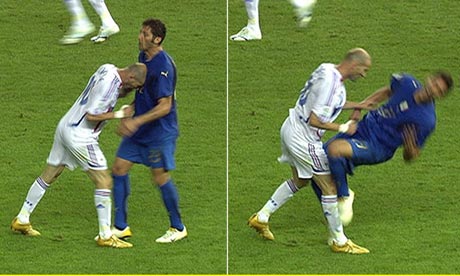
Zidane giving Italy's Materazzi a piece of his mind, using his head, and aiming it at Materazzi's tummy.

If a religion disallows homosexuality, certain people of that religion might take it to the next level by not just disallowing, but condemning homosexuality AND homosexuals. LGBT activists counter by holding protests or demonstrations.

Relationships between these two parties become strained. With the world already being torn apart by different political, social, and religious ideologies, I don't think it needs any more assistance.

The world has its share of extremists. And I mean that in an everyday sense.

Accepting a person's lifestyle is one thing. Accepting who they are as humans, is a different thing altogether. Some people may be in support of the LGBT lifestyle, some may not be. That's one case. But what I feel is this -- what really matters is that people accept someone of that community as a person and as a friend.


Nisha Ayub of the Pink Triangle Foundation.

Certain people may not agree with the LGBT lifestlye. Similarly, a transgender may not agree with a Christian lifestyle. Both parties have the rights to their own ideas and principles. Neither can impose their beliefs on the other party.

So what if one person's 'straight', while the other isn't?  Does that mean one is superior to the other?

Not at all. We're human, one and the same. It all boils down to a relationship of respect.

I cannot make a friend eat barbecued meat with me if he's a vegetarian. But would I hate him for it? People have different ways of life, and different ideas about things. It doesn't mean we should shun that person based on his beliefs or lifestyle. 

Should different viewpoints cause persecution? Should that cause hatred?

I don't see why it should!

In the same way a Chelsea fan and a Manchester United fan can watch a game together at the local mamak stall - each staying true to his beloved club without condemning or rejecting the other - I dream that the world will be this way one day.

Transgender or not, we have the same ability to feel, love and value one another as human beings. This world would be a happy place if we could love, value and above all, respect one another.


By Junmey

Wednesday, 23 May 2012

The Music Within

My mother once told me that every culture in every part of the world has its own form of music, in their own tongue.

I suppose that comes from humans' need to express emotions and feelings. Nowadays, South Koreans have been making waves with their K-Pop songs, matching their music with clever dance routines. Meanwhile, America has seen its music grow from the likes of Motown hits and 70's rock to today's mainstream Pop, largely dominated by artists such as Beyonce and Justin Bieber (talent is questionable).

Music is just as deeply engraved in aboriginal culture as it is in urban culture.

In certain African tribes, songs are very important to villagers, especially during crucial transitions of their lives. Pregnant African women meditate until they believe that they have heard their unborn children's songs.

Each unique melody would become part of every child's life. That is, when a child grows throughout his adolescence, his transition to manhood, his marriage and eventually his death. It will be sung to him by his loved ones. It seems as if music is embedded in their very being, in their lives - that it represents who they are and their individual souls.

 
A performance of the Kadazans' traditional Sumazau dance.

For the Maasai tribe of Kenya, music is the centre of their Eunoto ceremony, where young people who've come of age dance (read: flirt) to the beat of the songs. Men line and chant, while the women stand in front of them, singing in response. A musical dialogue takes place between the two sexes, as their voices create harmony.

This is similar to the Malaysian Kadazans' Sumazau dance which require couples and groups to dance to the symphony of "tagung"s and "sompoton"s, which are traditional musical instruments.

They also sing during rice festivals, just like how you sing in the shower, for personal entertainment.
 
In "The Aborigines Who've Walked for 40,000 Years", an article written by David Vanne, an Australian aborigine tells him about how some songs by his tribe are actually tunes laced with moral values and warnings for women, reminding them to be cautious not to lose their children or defy their husbands.

These tribal songs serve different purposes, and mean different things to different tribes of aborigines of the world.

Earlier in March, I had the privilege of meeting Antares, who was a bandmember of Akar Umbi, a band famous for its indigenous music. A few tracks from their album, "Songs of the Dragon" were used in the Portraits of Perseverance documentary. Singing those songs was none other than a Temuan grandmama, Mak Minah Angong.

According to Aliran.com, Mak Minah’s songs portray the love the Temuan people have for great nature. But the music goes deeper. It is not just about mere love songs to the environment, but to their ancestral land, and to their ancestors who are believed to have lived, and continue to live on in the landscape.


Mak Minah Angong (Credits to Magick River, photography by Peter Lau)


When logging and rock blasting began as part of the Sungai Selangor dam project, the Temuan families living in Pertak and Gerachi had not been properly resettled, many retreating further into the forest, so it seems. And in songs such as "Sungai Makao", Mak Minah's voice is reminiscient of better times where the land was still pristine.

In a way, the songs seem to echo memories of what used to be. 

It will not only be perfect for storytelling-time for the younger Temuans, it will also allow non-Temuan listeners to come to know about the land that is slowly being taken away from them.

The beautiful lullabies stand for the Temuan identity, voicing their intimate relationship with the environment. They represent a tapestry of the Temuans' lives.

Now that trees are being cut and jungles are getting smaller, the Temuans find it more and more difficult to live the 'old ways', even more so now that they have been relocated, and a large part of their ancestral land has been flooded to build the Sungai Selangor dam.


The late Mak Minah on a beach in Batu Ferringhi (Credits to Magick River, photography by Rafique Rashid)


According to Antares, they are beseiged by changes around them. Most of the children in Kampung Pertak - Mak Minah's village - do not finish secondary school as there is a lack of the "studying for certificate" culture at the home front. Girls marry young to become homemakers. Men do low-level odd jobs. When they need money, they go out to find work.  

Many of the villagers are lost. They are trying to pick up modern city culture - its language, music, the way city folk dress and their behavior. By doing so, they are beginning to lose what they used to have. And they don't realize how much they have lost in order to blend into modernity, by wearing a pair of jeans, or by listening to music with a heavy background of the electric guitar and drums, or by eating a slice of pizza given by a local tourist.


Mak Minah and her sister, Indah. (Credits to Magick River, photography by Antares)

Mak Minah's lullabies are no longer sung by the women in her tribe. Only her sister has learned a few lullabies from her. But even so, her sister has no one to sing to because young mothers now put on a tape player for music.

Their music is getting lost in times.
Maybe, just maybe, the world will find room, permanently, for their lullabies.

Someday.

By Junmey

Monday, 21 May 2012

No Need To Discriminate Me-lah.


I went up to the counter and handed the immigration officer my passport and boarding pass. He checked my boarding pass first, and then he opened my passport. His expression changed. His eyebrows cocked.

"Oh God," I said to myself. "Please don't ask that question....!"

He looked at me, and then my passport. He looked at me again, then my passport. Me. Passport. Me. Passport.

Finally he said, "You Cina ke? Cina apa?? (You're Chinese? What kind of Chinese are you??)"  Another officer came over to look at the passport. Together, they queried me with their solemn facial expression.

I sighed. Yup, that's the question I dreaded to hear. "Saya campur (I'm a mix)," I said.

"Ooooh, mix what?" they would ask.

And then I'd have to tell them, "Dutch, and Chinese."  I was aware of the line behind me, but the immigration guys didn't seem to care.  When they were satisfied with more clarifications from me -- I studied in which local school and I speak Bahasa,  they gave me back my passport and let me through.  I heard the two of them giggling behind my back.

For years I have been facing the same passport problem over and over again. My 'race' is defined as 'Chinese'. There were many times where I had to present my IC ( identification card ) as well as my passport, because they thought my passport was a fake. How many mat salleh ( Bahasa : white person ) in Malaysia have 'Chinese' as their 'race'?

This problem arose when I was twelve years old -- the year to be recognized as a citizen in Malaysia.

I went to get my IC done at the Dept of Registration.  I asked the officer if I could put my 'race' as 'Mix'.

"Tak boleh! (Nope!)" she said firmly.  I only had three choices: Chinese, Indian or Malay. It didn't make sense to me. I'm a mix of two bloods, not a pure breed Chinese! I pleaded again and again to the officer to let me put my 'race' as 'mix'.  

I told her that a friend of mine was half British and half Malay, so he became a 'Malay' but he also wanted to be a 'mix'. I asked, "Why?" 

The more I pleaded for her to reason with me,  the more she was annoyed.

Finally, I asked if I could tick the last box and be a "lain-lain (others)".  And I got a 'no' as well. So in the end, the only choice I had was 'Chinese'.

And so began the "What kind of Chinese are you?" question every time I present my passport at the Malaysian immigration.  Obviously, I don't look like a typical Chinese if I have European blood.

At one point, a Singaporean immigration officer thought I was being kidnapped and smuggled into Singapore by a whole car load of Chinese  -- my uncle and his wife, my grandparents, my mom and my cousin sister.


When I attended the 2011 Fashion and Sense (Miss Transgender Malaysia) competition, the question given to Miss Sarawak was, "Do you think passports should be issued for transgenders?" Her answer was obviously a 'yes', and the crowd went wild as most attendees were from the transgender community.

I sat there and thought about it.

I could imagine what they have to face when they present their passports to the officers. Instead of the immigration officer asking, "Cina apa?" like what get, the immigration officer would probably ask, "Lelaki apa? (What kind of man are you?)"

How are they supposed to answer that????? "Saya campur..... ( I am a mix?????)

How would a transgender feel when she is asked a question like that ( with officers giggling behind her?)  Does she feel 'injustice', anger, slighted?

If I feel 'unfair' being categorized into boxes that don't define who I am but being forced to be who I am not, and I am utterly unhappy, then how about the transgenders? They don't get this treatment just at the immigration offices, they get it at clinics, hospitals, job interviews and everywhere!

How can we be 1Malaysia if we are still categorized like this? If Malays, Chinese, and Indians are 'Malaysians' and they have their own little 'categories' in ID cards and passports, what about those of mixed parentage, especially those who are half European, half African or do not have the typical Malaysian Malay, Chinese and Indian looks?  Does that mean I am only HALF Malaysian?

It is easy to wear a 1Malaysia t-shirt and say 'Satu Malaysia!" and see all sorts of money being poured into campaigns. But just how 1Malaysia are we?

If we claim that we are 1Malaysia, then does any one of us have any right to stop a transgender to be who she is?